Part 2:
Defending Against Zero-Day Attacks in an AI-Driven World

In Part 1 of this series, we explored how zero-day vulnerabilities have become one of the most dangerous cyber threats facing modern financial institutions. Because these vulnerabilities are unknown at the time they are exploited, traditional security strategies built around prevention and patching are often ineffective.
As financial institutions move deeper into an era shaped by artificial intelligence, cloud infrastructure, and hyperconnected digital ecosystems, defending against unknown threats requires a fundamentally different approach. Organizations must now assume that vulnerabilities exist within their systems and design cybersecurity programs that emphasize visibility, containment, and resilience rather than absolute prevention.
Defending against zero-days in an AI world is not about completely eliminating the threat, but about minimizing the attacker dwell time, limiting the impact of a breach, and ensuring that institutions can detect, contain, and recover from incidents before they escalate into systemic disruptions.
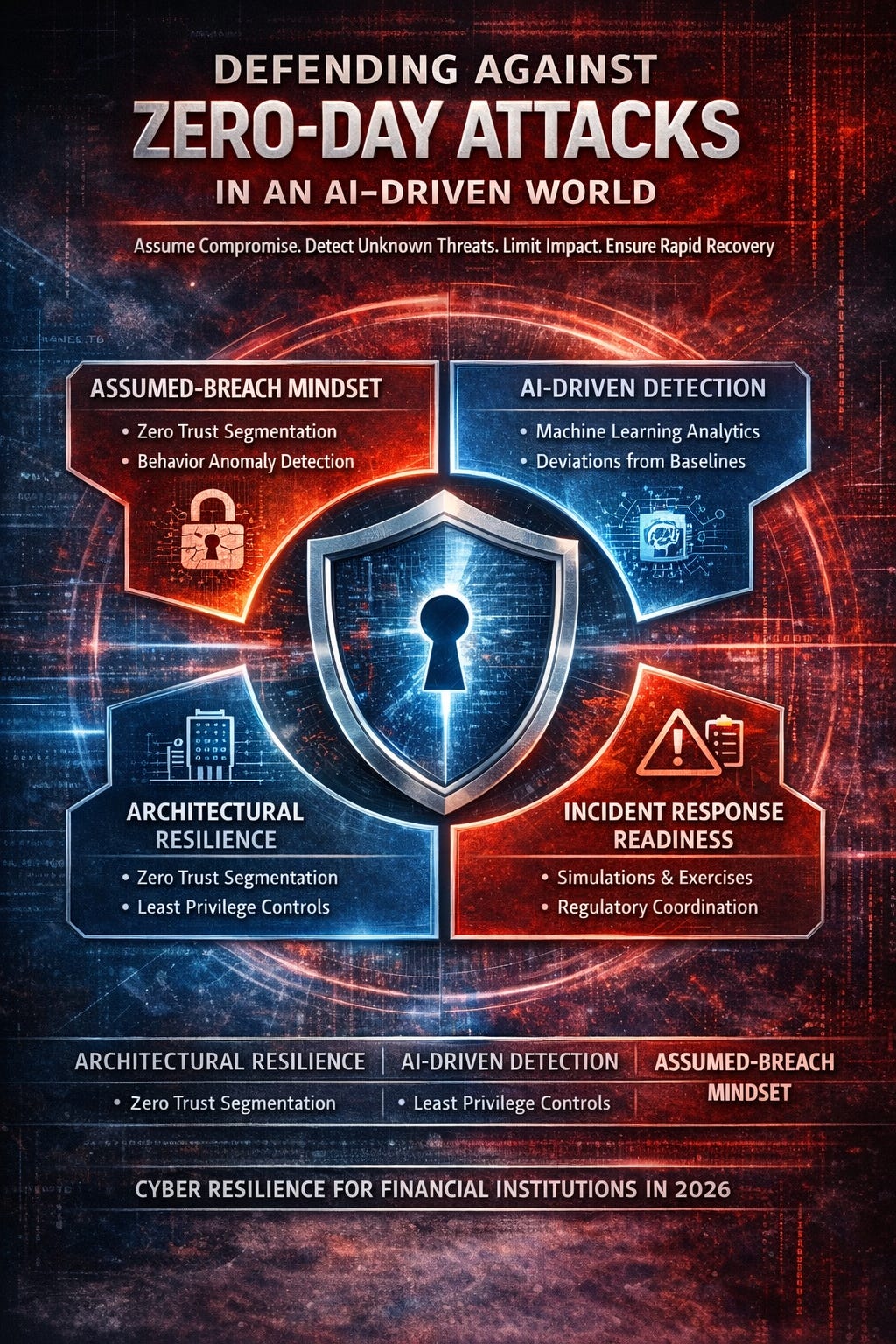
The following are the key takeaways from this discussion:
• Zero-day attacks exploit unknown vulnerabilities, making traditional prevention-focused security strategies insufficient.
• Financial institutions must adopt an assumed-breach mindset that prioritizes rapid detection and containment.
• Artificial intelligence can enhance cybersecurity defenses by identifying abnormal behavior that signals unknown exploitation.
• Architectural controls such as Zero Trust, segmentation, and least-privilege access significantly reduce the impact of successful attacks.
• Government threat intelligence sources such as the CISA Known Exploited Vulnerabilities Catalog help institutions prioritize remediation.
• Incident response readiness, including simulations and tabletop exercises, is critical for minimizing operational disruption.
• Cybersecurity is now a board-level governance issue affecting regulatory compliance, financial stability, and customer trust.
• In a rapidly evolving threat landscape, resilience, not perfect prevention, is the foundation of effective cyber defense.
From Prevention to an Assumed Breach Mindset
Traditional cybersecurity models were built around the idea that threats could be identified and blocked before they caused harm. Zero-day attacks challenge that assumption. When a vulnerability is unknown to vendors and defenders alike, there is no patch available and no signature to detect it.
Due to this, modern cybersecurity strategies increasingly adopt an assumed breach mindset, where organizations design systems under the assumption that attackers may eventually gain access.
This shift is reflected in modern cybersecurity guidance from the Cybersecurity and Infrastructure Security Agency and the National Institute of Standards and Technology. Both institutions emphasize continuous monitoring, strong identity controls, and zero trust architectures that minimize implicit trust within networks.
Under an assumed-breach model, the central question changes from “how do we prevent all attacks?” to “how quickly can we detect abnormal behavior and prevent a localized intrusion from becoming an enterprise-wide compromise?” CISA on Zero Trust, NIST Cybersecurity Framework
Using Artificial Intelligence to Detect Unknown Threats
Artificial intelligence has accelerated the speed at which attackers discover vulnerabilities and develop exploit techniques. However, the same technological advances can also strengthen defensive capabilities.
Modern cybersecurity platforms increasingly use machine learning to analyze large volumes of system activity and establish behavioral baselines across networks, applications, users, and devices. Rather than relying solely on known malware signatures, these systems detect deviations from normal patterns.
Examples of suspicious activity that AI systems may detect include:
unusual privilege escalation
unexpected lateral movement across systems
anomalous API calls
irregular data access patterns
abnormal login behaviors
Because these signals reflect behavioral anomalies rather than known attack signatures, they can reveal zero-day exploitation even when the underlying vulnerability remains unknown.
However, organizations must avoid overreliance on automated systems. AI-driven security tools are most effective when integrated with human-led security operations teams that can interpret alerts, investigate anomalies, and coordinate response efforts. IBM
Architectural Resilience
When a zero-day exploit succeeds, the damage it causes often depends less on the vulnerability itself and more on how the surrounding environment is designed.
Architectural resilience therefore plays a crucial role in reducing risk. Strong identity management, network segmentation, and least-privilege access controls can significantly limit an attacker’s ability to move laterally once they gain initial access.
Zero Trust architecture is particularly important in this context. By continuously verifying user identities and device integrity before granting access to systems, organizations reduce the likelihood that a single compromised account or device can expose an entire network.
For financial institutions, where critical systems such as payment platforms, customer databases, and trading systems coexist within interconnected environments, limiting blast radius is essential to preventing widespread disruption. NIST. SP.800-207
Threat Intelligence and the Known Exploited Vulnerabilities Catalog
Although zero-day vulnerabilities begin as unknown threats, they quickly become known once attackers start exploiting them in the wild. Rapid threat intelligence sharing therefore becomes critical.
The United States government maintains the Known Exploited Vulnerabilities (KEV) Catalog through the Cybersecurity and Infrastructure Security Agency. This catalog tracks vulnerabilities confirmed to be actively exploited and provides guidance for prioritizing remediation.
For financial institutions, monitoring KEV advisories has become an essential part of vulnerability management. Regulators increasingly expect institutions to demonstrate that they are actively tracking and remediating vulnerabilities known to be exploited in the wild. CISA KEV
Incident Response Readiness as a Strategic Capability
Because zero-day attacks often bypass initial defenses, incident response readiness has become one of the most important determinants of cybersecurity outcomes.
Organizations that develop clear response procedures, define escalation paths, and conduct regular simulation exercises consistently respond to incidents more effectively than those that do not.
Effective incident response in 2026 extends beyond technical containment. It also includes:
coordinated communication across executive leadership
regulatory notification procedures
collaboration with third-party vendors
forensic investigation and recovery planning
Frameworks such as the MITRE ATT&CK framework help organizations model attacker behavior and develop more realistic response strategies. MITRE ATT&CK®
Governance and Board-Level Oversight
As cyber incidents increasingly threaten operational continuity and financial stability, cybersecurity has become a core governance issue.
Boards and executive leadership teams are now expected to understand how cyber risks, including zero-day exploitation, affect business resilience, regulatory compliance, and reputational trust.
The World Economic Forum has repeatedly emphasized that cybersecurity should be treated as an enterprise risk management issue rather than solely a technical problem.
Organizations that integrate cyber risk into enterprise risk management frameworks are better equipped to make informed decisions about technology investments, incident response strategies, and regulatory obligations. Reports | World Economic Forum
Regulatory Alignment: FFIEC, NIST, and ISO
Cybersecurity expectations for financial institutions increasingly converge around three major frameworks:
the Federal Financial Institutions Examination Council Cybersecurity Awareness | FFIEC
the National Institute of Standards and Technology Cybersecurity Framework | NIST
the International Organization for Standardization ISO/IEC 27001:2022 - ISO
While each framework approaches cybersecurity from a different perspective, they share a consistent principle: organizations must design systems that assume unknown vulnerabilities will exist.
FFIEC guidance emphasizes governance, threat intelligence integration, and operational resilience. NIST frameworks focus on detection, response, and recovery capabilities. ISO standards approach the problem through formalized risk management and continuous improvement processes.
Together, these frameworks create a comprehensive foundation for managing zero-day risk in financial institutions.
Conclusion: Resilience Is the Real Defense Against Zero-Days
Zero-day vulnerabilities will remain an unavoidable reality of the modern digital ecosystem. As technology systems grow more complex and interconnected, the likelihood that unknown flaws exist somewhere within the infrastructure becomes increasingly certain.
What distinguishes resilient financial institutions from vulnerable ones is not the absence of breaches, but the ability to detect, contain, and recover from them quickly.
Organizations that adopt assumed breach models, invest in behavioral detection technologies, strengthen architectural resilience, and embed cybersecurity into governance structures will be far better prepared to confront the next generation of cyber threats.
In an AI-driven world, the most effective defense against zero-day attacks is not perfect prevention, but institutional resilience.